Head and neck squamous cell carcinoma (HNSCC) remains a leading cause of cancer deaths worldwide with ~500,000 cases/year. Cisplatin is the gold standard systemic agent for HNSCC. Cisplatin resistance, both intrinsic and acquired, has been described in preclinical models and is frequently encountered in clinical practice; when it occurs, it is deadly. The overarching goal of H-CARR is to develop a robust biological understanding of the key drivers of cisplatin resistance in HNSCC and develop the means of detecting it early in development and overcoming it once it arises.
H-CARR team previously showed that: 1) cellular processing of cisplatin-generated metabolic stress is a critical driver of sensitivity and/or resistance and 2) coordinated genomic (TP53 mutation) and transcriptomic (Nrf-2 activation) reprogramming is essential to organizing the metabolic response to cisplatin generated stress. H-CARR brings together biological and metabolic models of cisplatin resistance and extensive translational capabilities to image tumor metabolism non-invasively and detect biological shifts using circulating tumor cells (CTCs), providing a comprehensive window into development of cisplatin resistance.
H-CARR investigates convergent mechanisms of treatment resistance, altered metabolism and suppressed anti-tumor immunity synergistically and iteratively via 3 Research Projects:
Project 1:
Metabolic adaptation enables cisplatin resistance and inhibits tumor immunity
Project 2:
Defining the role of KEAP1/NRF2 signaling dysregulation and sensory nerve reprograming during acquisition of cisplatin resistance and metastasis in HNSCC.
Project 3:
Quantification of cisplatin sensitivity and resistance using metabolic imaging and circulating tumor cell (CTC) biomarkers.
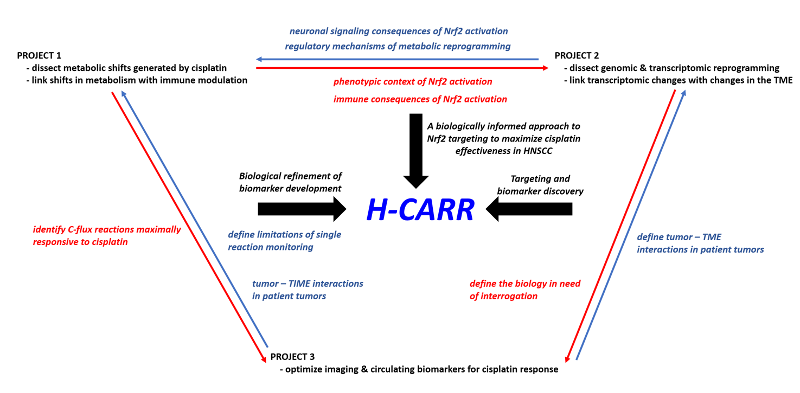
H-CARR is supported by a robust administrative and analytical infrastructure organized into 3 Cores.
An Administrative Core provides critical centralized support to H-CARR investigators and ensures seamless interactions and integration between the three projects and cores within the center as well as the broader ARTNet community.
A Systems Bioinformatics Core coalesces the data streams from all 3 Projects into one coherent multi 'omics understanding of cisplatin response and development of resistance.
A Tumor Model and Biospecimen Repository Core provides H-CARR investigators with a centralized facility that ensures the systematic collection, processing, storage, and distribution of peripheral blood, surrogate and specialized specimens, and samples of head and neck squamous cell carcinoma (HNSCC) from patients.


(For additional information, please visit NIH RePORTER)

